If there is one tree that symbolises Italy’s great urban avenues, it is the plane tree. Choosing a plane tree at the nursery means selecting a species capable of withstanding some of the most difficult urban conditions while retaining strong architectural value in the project over time.
Why the plane tree is the avenue tree par excellence
The genus Platanus has long been associated with the great tree-lined avenues of Italian and European cities, where its broad crown and vigorous growth create an immediately recognisable visual effect. It is a species that has remained a benchmark in urban landscape design for centuries.
Characteristics of Platanus at the nursery
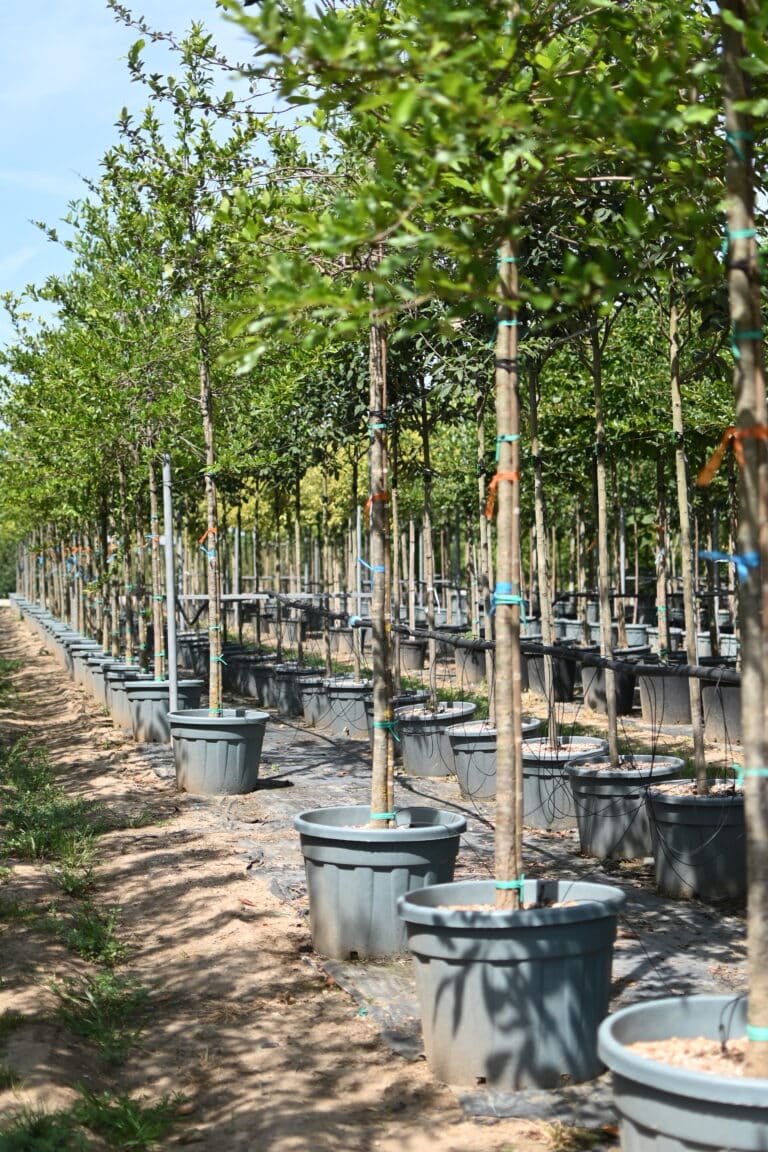
At the nursery, plane trees are selected for balanced structure and a straight trunk, both essential characteristics for specimens destined for regular avenues and rows. As with oak, it is a long-lived species, so the quality of early establishment influences the result for decades.
Resilience and adaptability in urban settings
Plane trees are known for their tolerance of compacted soils, pollution and severe pruning, all common conditions in dense urban environments. This resilience makes them a reliable choice for projects where other species would struggle to establish with the same consistency.
Uses: avenues, squares and large public landscaping projects
The plane tree remains one of the most requested species for large public landscaping tree-supply projects, where avenues and squares require uniform, reliable specimens at scale. For girths and availability of our plane trees at the nursery, contact our team for a technical assessment tailored to the project.